Mobile applications face a growing range of security threats, from reverse engineering and code tampering to application repackaging, runtime manipulation, and unauthorised access. Mobile app shielding can add a layer of protection directly to an application, helping security teams defend the app while it is running.
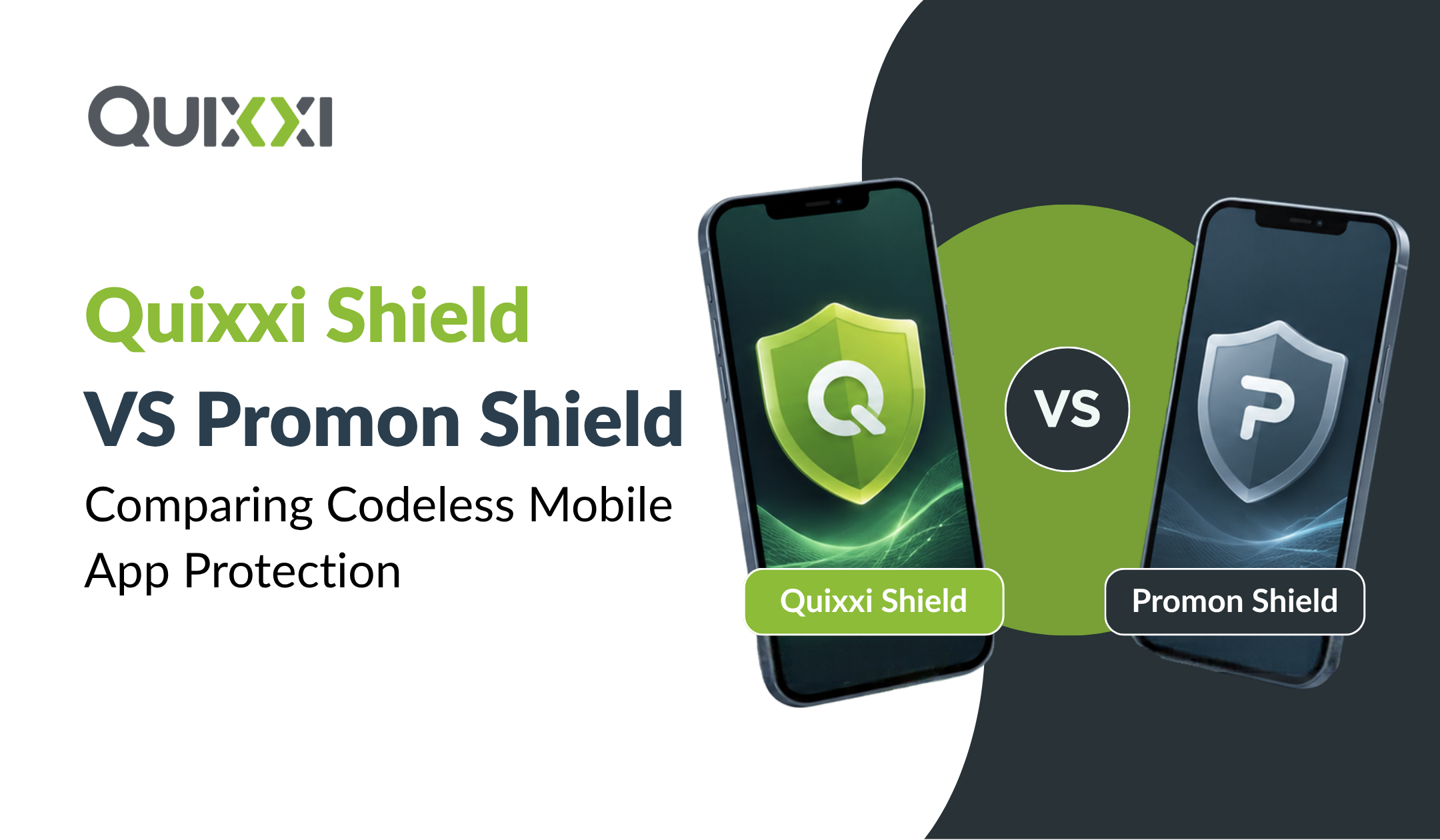
Two solutions that address this area are Quixxi Shield and Promon Shield for Mobile. Both provide multi-layered protection for mobile applications and use runtime security controls to help defend against attack. However, there are differences in how each solution fits into the wider mobile application security lifecycle.
Quixxi Shield: Codeless and configurable mobile app protection
Quixxi Shield is designed to protect Android and iOS applications without requiring developers to modify their application source code. Quixxi describes Shield as a codeless, drag-and-drop solution that applies multiple security layers to mobile applications. Security settings can be configured through the Quixxi platform, allowing organisations to tailor protection to their application requirements.
Quixxi Shield includes protection against several common mobile application threats, including:
- Code tampering
- Application modification
- Runtime attacks
- Debugging
- Rooted or jailbroken devices
- Emulator-based attacks
- Application integrity issues
- Unauthorised modification
Quixxi also uses techniques such as string protection, code obfuscation, method and field randomization, library protection, and integrity verification to make applications more difficult to analyse or modify. Its RASP capabilities can also detect runtime conditions such as USB debugging, emulators and rooted or jailbroken devices, with configurable response including application termination.
Promon Shield: Post-compile runtime protection
Promon Shield for Mobile takes a similar no-code approach but places a strong emphasis on runtime protection and application hardening.
Promon states that Shield can be applied post-compile, without source-code changes, and can work across native, hybrid and cross platform application environments. It is also designed to integrate with CI/CD workflows.
Promon Shield protects applications against threats including:
- Tampering
- Reverse engineering
- Repackaging
- Code injection
- Debugging
- Malware
- Rooted and jailbroken devices
- Compromised execution environments
Promon also provides DEX encryption within Shield for Mobile to add another layer of protection against static analysis and code extraction on Android.
Quixxi: From vulnerability assessment to runtime protection
One of the key characteristics of Quixxi is that Shield sits within a broader mobile application security workflow. Quixxi’s platform is structured around:
SCAN
Quixxi Scan provides SAST and DAST vulnerability assessment, along with API scanning, to help identify application security issues and provide recommendations for remediation.
SHIELD
Quixxi Shield adds multiple layers of protection to the mobile application, including RASP, anti-tampering and reverse engineering protection.
SUPERVISE
Quixxi Supervise provides runtime monitoring, analytics, security event information and application management capabilities.
SCAN → SHIELD → SUPERVISE
The idea is to support security across different stages of the application lifecycle, from identifying vulnerabilities to protecting the released application and monitoring runtime activity.
Promon: Runtime protection and security intelligence
Promon takes a broader platform approach centred around runtime protection and trusting security signals. Promon’s current platform is structured around several layers, including protect and collect, with products such as shield for mobile, code protect, data protect, verify and insight.
Shield provides the runtime protection layer, while other Promon products extend protection and visibility into areas such as:
- Code and intellectual property protection
- Sensitive data and secret protection
- Application and API verification
- Runtime visibility
- Security analytics
Promon Insights, for example, provides visibility into runtime behaviour and application security posture.
This gives Promon’s platform a broader runtime security model:
PROTECT → COLLECT → ANALYSE → ADAPT
Rather than treating Shield as an isolated security feature, promon positions it as part of a wider application security platform.
Codeless does not mean the same thing
Both vendors emphasis simplified deployment. Quixxi describes Shield as a codeless, drag-and-drop solution with configurable security controls available through its platform. Promon describes Shield as a post compile solution that requires no source-code changes and can be integrated into existing development and CI/CD environments.
Which approach should mobile teams consider?
The right solution depends on the organisation’s security requirements and existing development workflow. Teams looking for a platform that combines SAST, DAST, API assessment, application shielding and runtime monitoring may find Quixxi’s integrated SCAN, SHIELD and SUPERVISE approach relevant. Teams looking for post-compile runtime protection combined with additional capabilities for code protection, data protection, application verification and security intelligence may consider the broader Promon platform.
The important consideration is not simply the number of features. Security teams should evaluate how the product fits their application architecture, development workflow, deployment process and runtime security requirements.
The key takeaway
Quixxi Shield and Promon Shield address many of the same mobile application security challenges, including reverse engineering, tampering, runtime attacks and application integrity. The main difference is how each product fits into its broader security platform.
Quixxi Shield provides codeless and configurable mobile application protection and sits alongside Quixxi Scan and Supervise, creating a workflow that covers vulnerability assessment, application shielding and runtime monitoring. Promon Shield for Mobile provides post-compile runtime protection and forms part of a broader Promon platform that extends into code protection, data protection, application verification and runtime security intelligence. For organisations comparing mobile application shielding solutions, looking beyond individual security features can help identify which approach better fits their existing development and security processes.