Secure Every Release: A Developer’s Guide to Mobile CI/CD Pipeline Security
Today, with the rapidly evolving nature of mobile app development, not only the speed of app deployment but also security has become equally important. With organisations adopting agile software development processes such as continuous integration and delivery CI/CD, the rate at which mobile apps are being deployed has become incredibly quick.
However, it does come with greater vulnerability threats. With the new generation of CI/CD pipeline solutions, it is no longer about the process of delivery. In fact, the CI/CD pipeline solutions has now become the first line of defence for your mobile app. That is where you need DevSecOps platforms like Quixxi to be part of the equation.
Reason why CI/CD pipelines are ideal attack targets
CI/CD pipelines have close interactions with source code repositories, build system, testing frameworks, and deployment systems. This implies that they have many valuable resources.
Some of the common threats are:
- Unsecured access credentials for build systems
- Insecure third-party modules or software development kits added by the build systems
- Deployment of unsigned and unverified mobile binaries
- Slack access controls on CI/CD systems
- Bad code injection through plugins or dependencies
In case of compromise, attackers can modify production builds. This means that malicious code will eventually be delivered to users. In the case of mobile application, it becomes more dangerous since after deployment to app stores, it is difficult to have control over the apps.
The shift left initiative: Inclusion of security in CI/CD
Conventional methods of securing applications are usually done too late within the software development process. The later vulnerabilities are identified, the more expensive their remediation becomes. In the contemporary DevSecOps methodology, security features are built in right at the beginning of the CI/CD process. A typical secure mobile pipeline would have:
- Static Application Security Testing (SAST) when committing codes
- Dynamic Application Security Testing (DAST) during the building and staging processes
- API security testing during runtime simulation
- Binary security testing for identifying build-time security risks
- Security gates that facilitate security policy adherence before releases
As shown by the modern practice of securing mobile CI/CD
Important milestone in the mobile Ci/CD pipeline that guarantee security
1.Committing code and pre build security verification
In this phase, the developer commits changes to the code. These need to be verified first for:
- Quality and existing vulnerabilities within the code
- Detection of any secrets (API keys, credentials, etc)
- Dependency analysis for any known CVEs
2.Stage for validating security at build
After compiling the application, the application becomes a new security asset and no longer merely the source code itself.
Important controls are:
- Testing binary integrity
- Validation of the build
- Check for debug setting or insecure builds
- Prevention of malicious compilation processes
In the case of mobile applications, an important thing to consider is that security vulnerabilities can be added to the application at this stage as well.
3.Real world testing with dynamics
Whereas static analysis involves looking at the software from a distance, dynamic testing actually tests the software when its being used.
Examples include:
- User emulation
- API calls observation
- Session verification
- Insecure data storage detection
The main focus here is to ensure that the application works safely outside of its testing environment.
4.Security Gates and Enforcements
Security gates play a vital role in making sure that any discovered vulnerability is not detected but also mitigated.
CI/CD process enforces the following actions:
- Blocking of critical vulnerabilities
- Authorisation of risky exceptions
- Audit logging of all overridden decisions
- Traceability from commit to deployment
In this way, security becomes a control mechanism rather than simply a reporting activity.
Where most CI/CD pipelines go wrong
Even in the presence of automation, many pipelines suffer from structural deficiencies such as:
- No validation of Artifact Integrity
- Isolated security solutions that do not interact with each other
- Variable compliance from one environment to another
- Approval processes that involve humans and thus mistakes
- Insufficient insight into the run time behaviour after release
How does Quixxi improve the security of mobile applications?
Quixxi is a mobile-first platform for application security with capabilities to work seamlessly within DevSecOps pipelines and provide advanced protection through all stages of the mobile app lifecycle.
The following are some of the major functions of Quixxi’s application security solutions:
- Quixxi Scan (static & dynamic analysis): identifies issues with the source code and runtime applications, detects configuration weaknesses, poor handling of sensitive data, and exposure of APIs
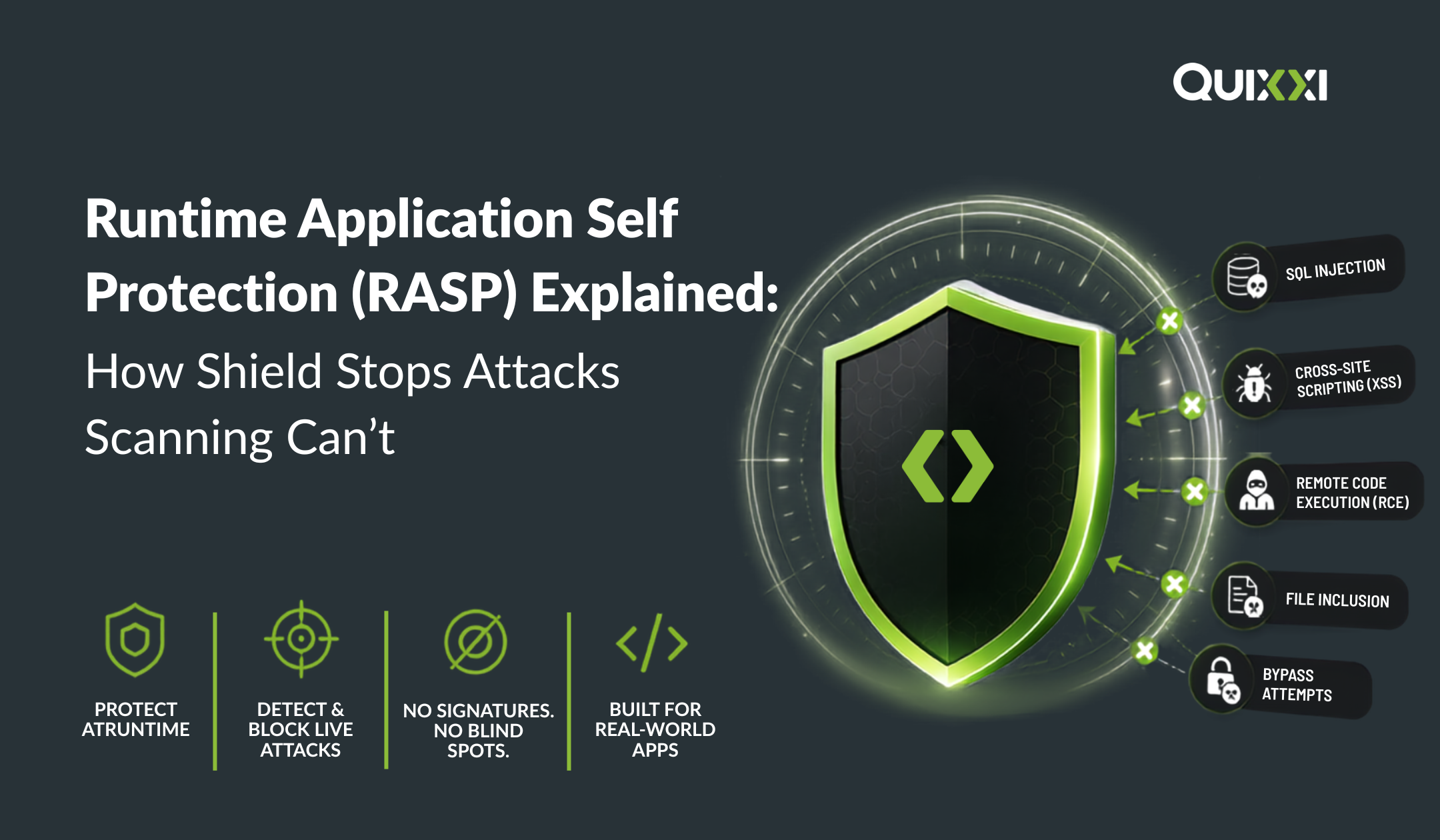
- Quixxi App Shield (Runtime Application Self-Protection & runtime security): ensures the security of mobile applications at runtime, detecting any attempts at tampering, reverse engineering, and exploitation; stops malware in its tracks
- Quixxi App Supervise (monitoring & threat detection): offers ongoing supervision of the applications, detecting any suspicious activity and threats to their safety
The Quixxi approach: Security without friction
At Quixxi, we believe that security should empower innovation, not impede it.
Our methodology is founded on three key ideas:
- Incorporate security within CI/CD processes to aid in development
- Automate detection and enforcement to minimise manual effort
- Ensure applications remain secure during execution, even after the CI/CD process
These guarantees developers work efficiently yet do so in a highly secure manner.
Final thoughts
Thanks to CI/CD pipelines, the development process has become much faster, but it has also become a much bigger target.
Organisations need to look at CI/CD as a security mechanism, and not simply as a delivery channel.
By implementing security measures throughout the CI/CD pipeline, and ensuring that they extend even into runtime, businesses can drastically improve their cybersecurity posture while retaining high-speed performance.
Using modern mobile security platforms such as Quixxi, organisations can easily achieve all these objectives.